USE CONTEXTS
Pigments manufacturers requirements drawn from process context
Hue, hiding, heat stability, and resin compatibility belong on the RFQ because coatings and plastics lines reject look-alike colorants. An application name is a context, not a product approval or a stock promise.
- Record the process, not only the market label.
- Keep Cosmetics, plastics, and industrial coatings on separate quote lines.
- Leave acceptance tests with the buyer laboratory.
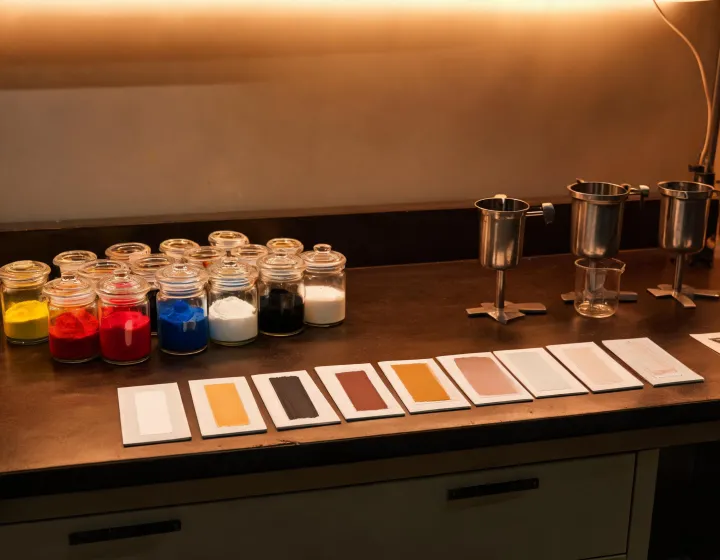
SPEC MATRIX
Translate a line into measurable purchase fields
The table below is a question list for pigments manufacturers. Cells stay blank until the buyer or the quoted mill fills them. Public product-family references such as SpecialChem help frame questions; they do not replace the exact SDS, TDS, or CoA.
| Process context | Fields to freeze | Still buyer-owned | Limitation |
|---|---|---|---|
| Architectural coatings | Color Index, resin system, solids if dispersed, weatherability questions | Fade and dirt-pickup acceptance | A family SDS is not the quoted pigment SDS |
| Industrial metal coatings | Heat stability, hiding, particle profile, grind stage | Salt-spray or chemical-resistance sign-off | This desk does not hold OEM approvals |
| Plastics masterbatch | Heat history, carrier resin, moisture, pellet or powder form | Warpage and migration tests | Lab methods stay with the buyer |
| Color cosmetics | Intended use, purity questions, package size | Cosmetic-file and labeling decisions | Status is a supplier statement to verify |
Method trade-offs buyers still have to choose
Organic pigments often trade chroma against weatherability. Inorganic pigments may change hue and hiding while shifting heavy-metal questions. Dry powder simplifies freight but raises dust and wetting work. A pigment dispersion can shorten grind time while adding carrier, solids, and viscosity fields that a powder quote never contained. None of those routes is declared a winner here.
Where a mill proposes a substitute Color Index or a different surface treatment, park it on a second row. Do not average unit prices across unmatched constructions. Flash point, UN number, and storage range still come from the exact SDS after the product is named.
APPLICATION DOCUMENTS
Use-context questions that do not replace SDS review
- Can an application name replace Color Index?
- No. Two pigments sold into the same coatings plant can differ in C.I. number, surface treatment, and particle profile. Put those fields on the RFQ.
- Who confirms cosmetic or food-contact files?
- The buyer and the quoted supplier. This site does not issue those letters and does not reuse another mill's file.
- What if only a shade name is known?
- State the known shade and leave Color Index open for supplier confirmation rather than inventing a standard.
- Does dispersion freight follow the same SDS as dry powder?
- Not automatically. Transport classification follows the exact product and concentration on the SDS that belongs to the quoted material.
Send a pigments manufacturers brief for factory quotes
Include Color Index, process context, quantity, packaging, US destination, and requested timing. Optional budget can note currency and whether it is per kilogram, per drum, or per order.